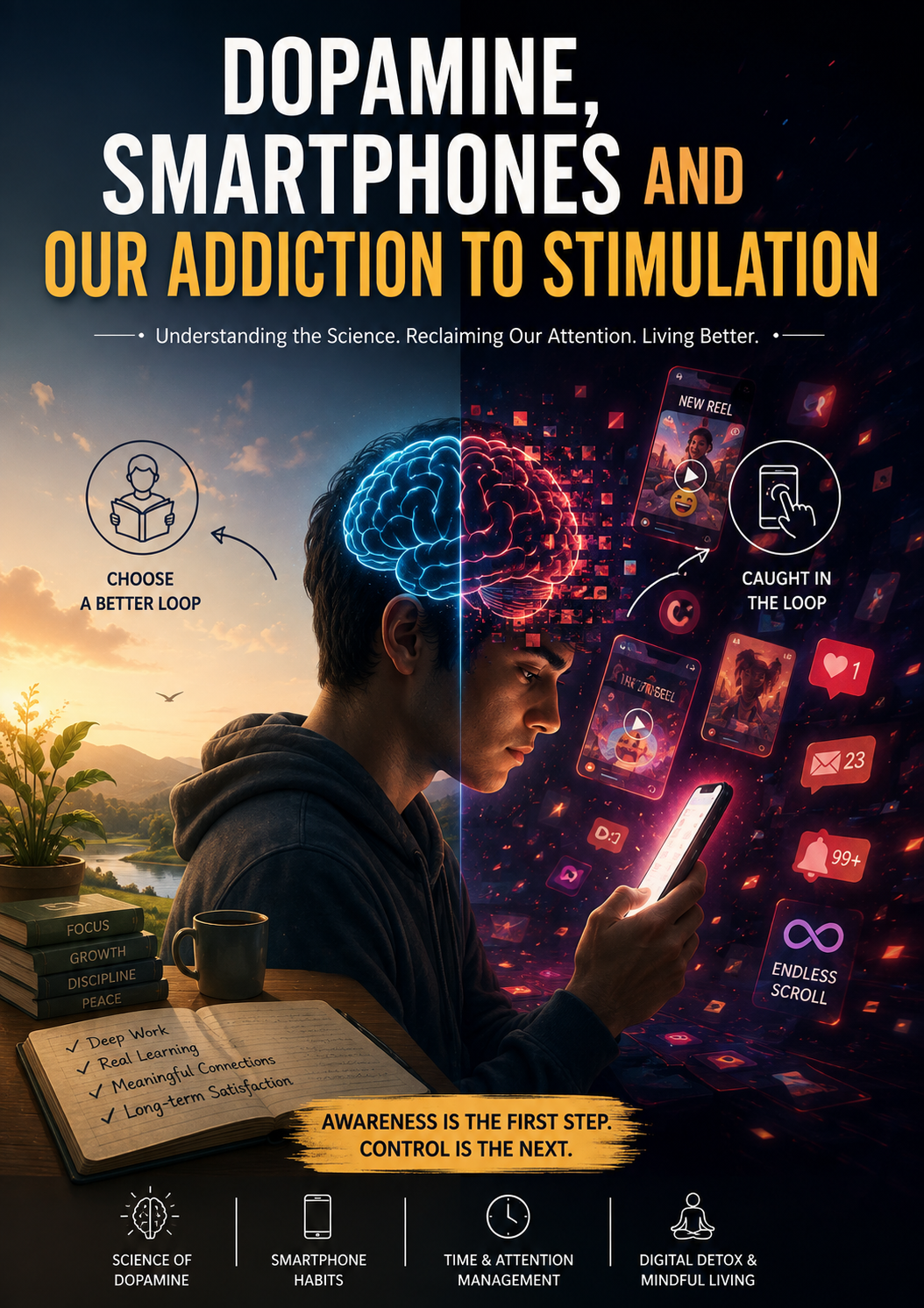
1. When entertainment became shorter, faster and harder to resist
A smartphone is one of the most remarkable inventions of our time. It keeps us connected, helps us work, gives us instant access to information, entertains us, manages our finances, captures our memories and has become an essential part of everyday life.
But something interesting has happened.
2. The device that was designed to serve us can sometimes begin to control us.
We may pick up our phone to check one important message or notification. Twenty minutes later, we realise that we have been scrolling through short videos, social-media posts or completely random content.
The troubling part is not simply the twenty minutes.
It is the automatic repetition.
We check the phone when we are bored.
We check it when we are waiting.
We check it when we are stressed.
We check it when we are tired.
Sometimes, we check it without even knowing why.
Why does this happen?
To understand this, we need to understand one fascinating chemical messenger in our brain:
3. What Is Dopamine?
Dopamine is a neurotransmitter—a chemical messenger that allows neurons to communicate with one another. It plays important roles in motivation, learning, reward, attention, movement and goal-directed behaviour. When a dopamine-producing neuron is activated, dopamine can be released from tiny storage structures called synaptic vesicles into the synaptic cleft, the microscopic gap between two neurons. The dopamine molecules then bind to receptors on the receiving neuron and influence its activity. After the signal has done its job, dopamine is cleared from the synapse through processes including reuptake and enzymatic breakdown, allowing the system to respond to subsequent signals. Importantly, dopamine is not simply a “pleasure chemical”; it is deeply involved in motivation, learning, reward prediction and reinforcement.
4. How dopamine travels between two neurons
Dopamine-producing neuron → Synaptic vesicles → Dopamine release → Synaptic cleft → Dopamine receptors → Signal in receiving neuron → Reuptake/breakdown
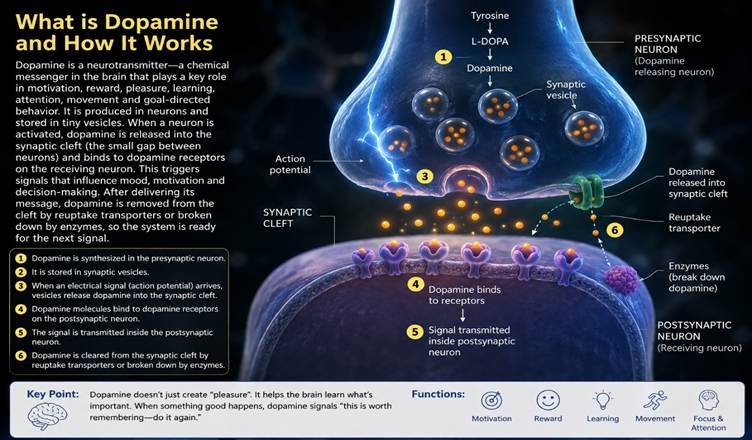
The fascinating part is that dopamine helps the brain learn what is important and what may be worth repeating. And this brings us to smartphones.
5. The Brain Meets the Smartphone
Modern digital platforms are remarkably good at providing novelty and unpredictable rewards.
You never know what the next swipe will bring.
Maybe the next video will be funny.
Maybe someone has sent you a message.
Maybe your post has received a “like.”
Maybe you will discover something interesting.
Maybe the next video will be emotionally exciting, surprising or simply more entertaining than the previous one.
That uncertainty can make the behaviour particularly compelling.
The cycle can look like this:
Boredom → Pick up phone → Scroll → Novelty/reward → More scrolling → Repeat
The important point is that the brain can learn this behaviour even when each individual reward is small.
Over time, boredom itself can become a cue to seek stimulation.
A notification, an empty moment, or simply the feeling of having “nothing to do” can trigger the urge to check the phone. That is why someone may unlock their phone almost automatically, without consciously deciding to do so.
6. From Long-Form Entertainment to 30-Second Shorts
Perhaps one of the most interesting changes in modern entertainment is not simply what we consume, but how quickly we receive stimulation.
Consider the evolution:
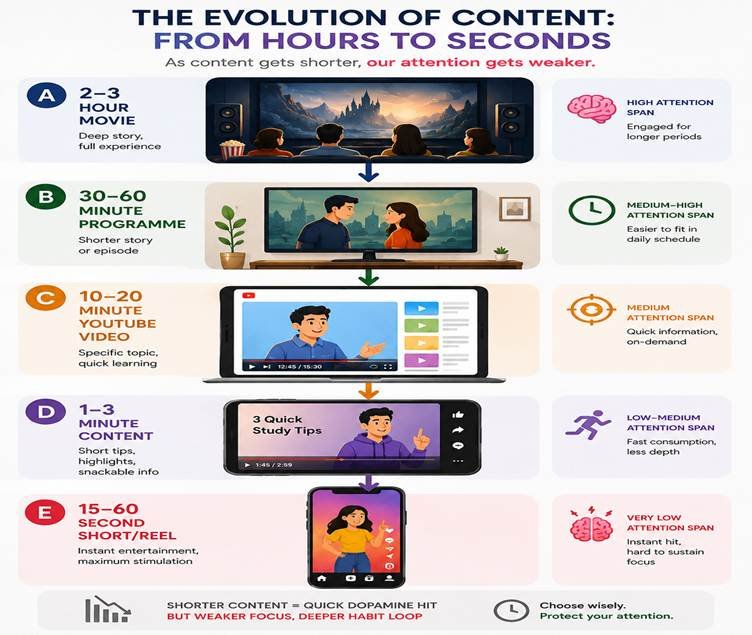
The interval between potentially rewarding experiences has become dramatically shorter.
- A book has a final page.
- A movie has an ending.
- A newspaper has a limited number of pages.
But an endless digital feed has no natural stopping point.
- There is always another video.
- Another message.
- Another notification.
- Another headline.
- Another recommendation.
- Another swipe.
- And therefore, another opportunity for novelty.
7. From Delayed Reward to Frequent Reward
Consider a traditional movie.
Story → anticipation → suspense → emotional build-up → climax → resolution
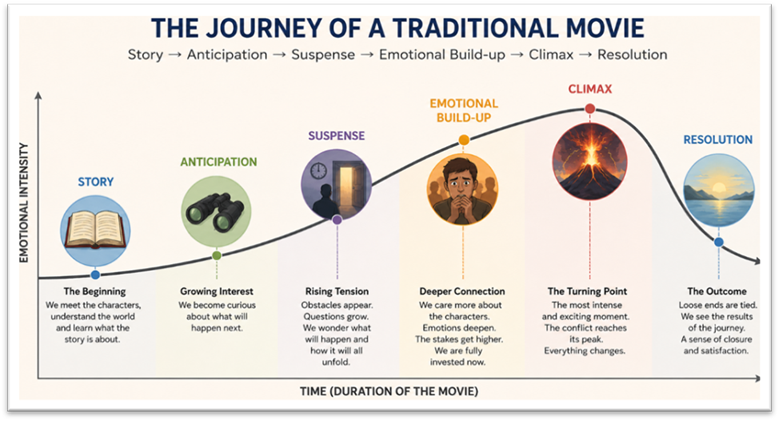
You may spend two or three hours following the story before reaching its major emotional payoff.
Now compare that with short-form content:
Swipe → novelty → reward
Swipe → novelty → reward
Swipe → novelty → reward
Swipe → novelty → reward
The fundamental change is therefore not necessarily that every short video produces “more dopamine.”
That would be an oversimplification.
The more useful way to understand it is:
Short-form platforms can create a high-frequency sequence of novelty, anticipation and reward-prediction experiences, repeatedly engaging the brain’s learning and reinforcement systems.
In other words:
The reward interval becomes shorter.
And the brain gets many more opportunities to encounter something interesting within a short period.
8. Dopamine: It’s Not About Keeping Blood Levels High
There is an important scientific distinction here. It would be incorrect to say that watching Shorts keeps blood dopamine levels permanently elevated or that the brain needs to maintain a particular blood concentration of dopamine.
Dopamine involved in brain signalling is primarily acting within neural circuits and synapses. Blood dopamine is not a simple measurement of what is happening with dopamine signalling inside the brain.
The more accurate question is therefore not:
“How high is my dopamine level?”
but:
“What behaviours is my brain learning to seek, and how frequently are those reward-related signals occurring?”
This distinction matters enormously when we talk about digital stimulation.
9. Why Faster Stimulation Can Become So Attractive
Imagine two different environments.
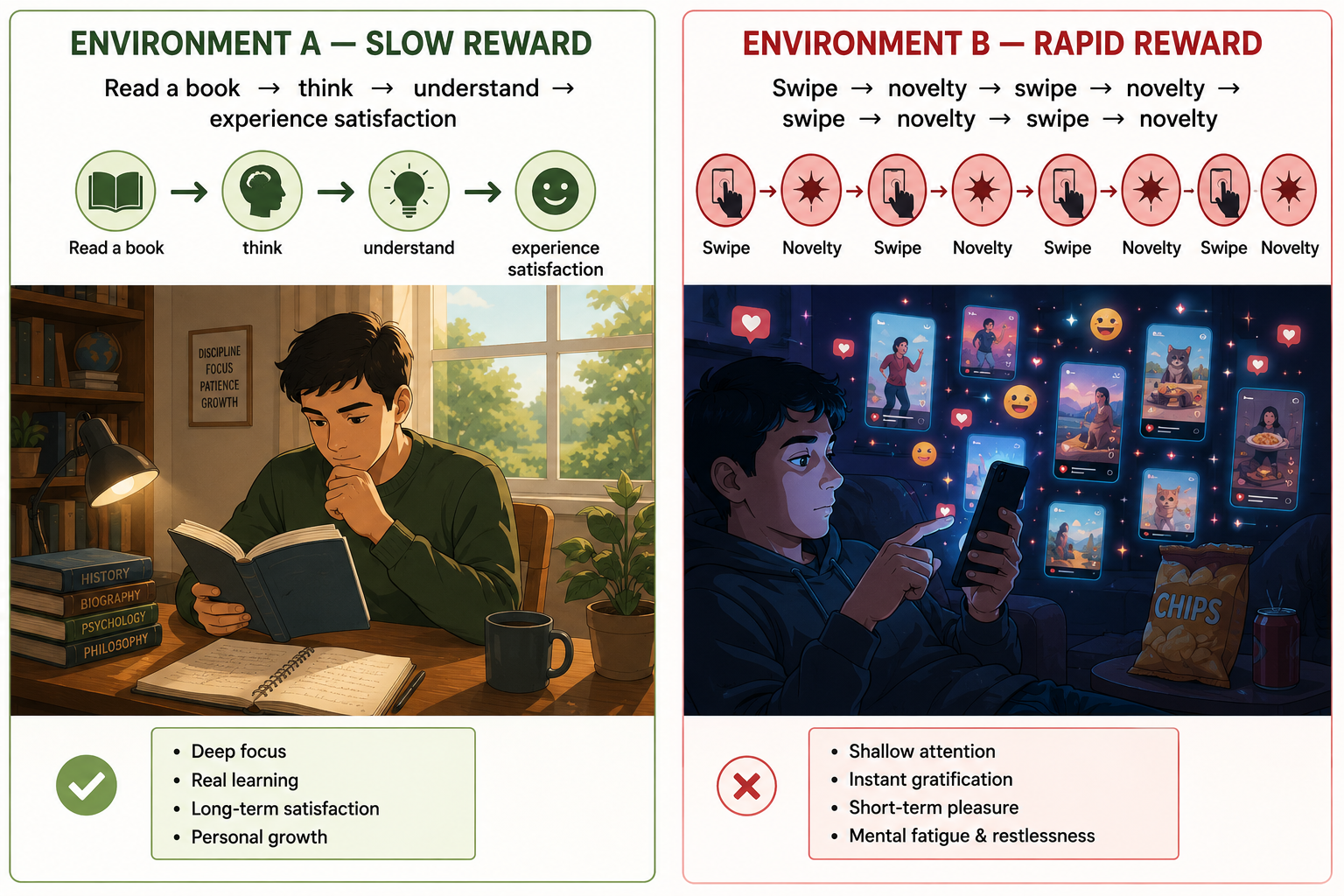
Neither environment is inherently “good” or “bad”.
But they train attention differently.
If we repeatedly expose ourselves to rapidly changing content, slower activities may initially feel unusually difficult.
- A book may feel boring.
- A long lecture may feel too slow.
- Studying may feel uncomfortable.
- A movie may seem to take too long to reach the point.
- Waiting may feel irritating.
- Silence may feel empty.
The mind begins looking for the next stimulation.
This does not mean that short videos permanently damage the brain or that they inevitably cause addiction. The science is more nuanced.
But repeated cue–reward experiences can contribute to habit formation and reinforcement, particularly when the rewards are unpredictable.
10. The Vicious Cycle of Stimulation
The process can gradually become:
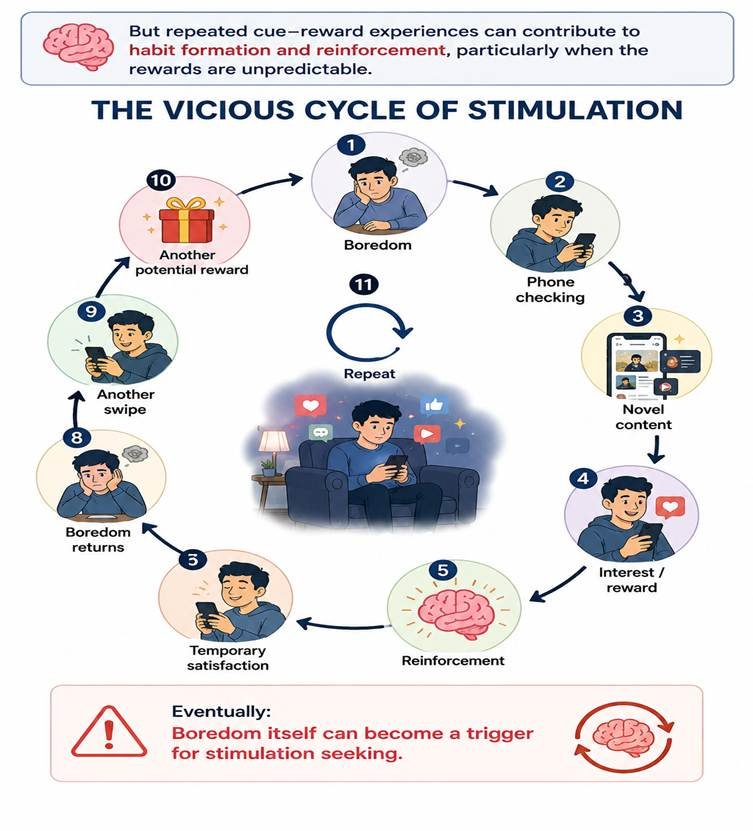
This is one of the most important things to recognise. The problem may not be the phone itself. The problem may be that we have gradually trained ourselves to escape every moment of boredom.
11. The Paradox of Modern Entertainment
Technology has not necessarily made every individual piece of entertainment more rewarding.
It has made potentially rewarding experiences:
More frequent.
More immediate.
More personalised.
More accessible.
More unpredictable.
Earlier:
Reward ←──── waiting ────→ Reward
Now:
Reward ↔ Reward ↔ Reward ↔ Reward ↔ Reward
The change may therefore be described as a movement from delayed reward toward high-frequency reward opportunities.
And this raises an important question:
What happens to our ability to tolerate boredom, waiting and delayed gratification when stimulation is available every few seconds?
12. Are We Becoming Addicted to Stimulation?
The word “addiction” should be used carefully.
Social-media overuse and compulsive short-form consumption are not identical to alcohol or drug dependence. Alcohol is a psychoactive substance that produces pharmacological effects and can produce tolerance, withdrawal and physical dependence.
However, there can be a behavioural similarity:
Alcohol dependence
Cue → craving → substance → pharmacological reward → temporary relief/reward → repeated use
Compulsive digital consumption
Boredom/cue → urge → phone → novelty/reward → temporary satisfaction → repeated checking
The underlying biology is different.
But both demonstrate an important principle:
Repeated reinforcement can strengthen cue-driven behaviour.
That is the more scientifically defensible comparison.
13. The “Dopamine Detox” Misconception
The term “dopamine detox” has become extremely popular. But you cannot simply “detox dopamine” from your brain. Dopamine is essential for normal human functioning. We need it for motivation, learning, movement and many other processes. The objective is therefore not to eliminate dopamine. It is not even to eliminate pleasure.
The real objective is:
To reduce compulsive stimulation and regain conscious control over our attention and behaviour.
A more accurate term might be:
Digital Detox
or
Dopamine/Attention Reset
The goal is simple:
Stop giving your brain constant, unnecessary stimulation and relearn how to enjoy ordinary life.
14. What Can We Do?
The answer is not to reject technology.
The answer is to change our relationship with it.
14.1. Remove the biggest trigger
Identify the application that consumes most of your unnecessary time.
It could be:
- Short videos
- Social media
- Random YouTube browsing
- Online gaming
- Constant news consumption
- Unnecessary messaging
- Other forms of endless scrolling
Instead of relying entirely on willpower, change the environment.
Make unnecessary stimulation harder to access.
14.2. Create phone-free periods
Start small. For example:
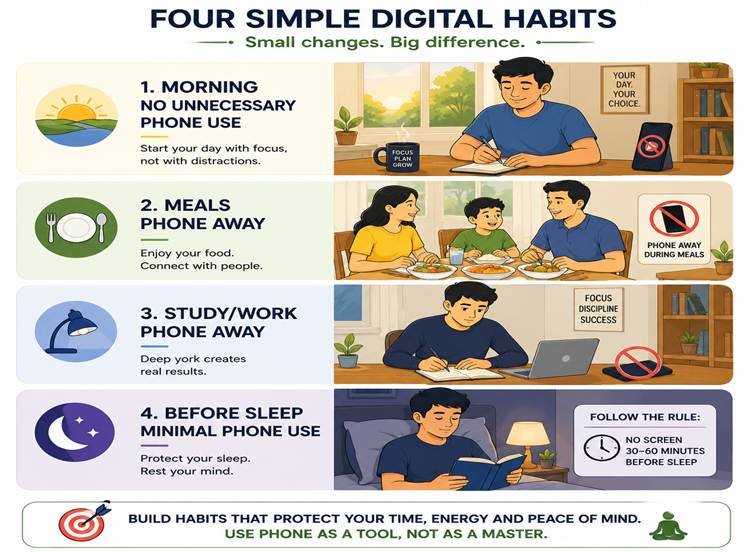
The purpose is not punishment.
It is to teach the brain:
“I can experience boredom without immediately escaping into my phone.”
14.3. Identify the emotional trigger
Before reaching for the phone, ask:
Why am I picking it up?
- Am I bored?
- Stressed?
- Lonely?
- Tired?
- Avoiding difficult work?
- Anxious?
- Or simply looking for stimulation?
When we identify the trigger, we have a chance to address the underlying need instead of automatically reaching for the screen.
14.4. Replace stimulation with meaningful activity
Simply removing the phone is not enough.
We need to replace the habit.
Try:
- Reading
- Walking
- Exercise
- Learning
- Writing
- Meditation
- Conversation
- Family time
- Creative work
- Time in nature
The goal is not to make life boring.
It is to rediscover the satisfaction that comes from deeper and more meaningful activities.
14.5 Rebuilding the Ability to Be Bored
Perhaps one of the most underrated skills in the modern world is the ability to do nothing for a while.
- Sit quietly.
- Walk without your phone.
- Look around.
- Think.
- Let your mind wander.
At first, this may feel uncomfortable. But boredom does not always need to be solved. Sometimes it simply needs to be experienced. When we stop filling every empty moment with stimulation, we create space for:
- Thought.
- Reflection.
- Creativity.
- Observation.
- Conversation.
- Rest.
14.6 From Passive Consumption to Active Creation
Perhaps the most powerful shift is this:
Consumer → Creator
Instead of endlessly watching:
Read.
Instead of endlessly scrolling:
Write.
Instead of consuming another motivational video:
Take action.
Instead of watching someone else’s life:
Build your own.
Instead of constantly seeking the next stimulus:
Become absorbed in something meaningful.
The brain can learn to associate satisfaction not only with instant novelty, but also with effort, progress, mastery and achievement.
15. The Real Detox Is Not From Dopamine
Dopamine is not the enemy. Technology is not the enemy. Social media is not automatically the enemy.
The real problem is:
Compulsive behaviour without conscious choice.
We don’t need to eliminate pleasure. We need to develop the ability to choose where our attention goes.
Instead of:
“I feel bored, so I will scroll.”
We should be able to say:
“I feel bored, and I can tolerate it.”
Instead of:
“I received a notification, so I must check it.”
We should be able to say:
“I will check it when I choose.”
Instead of:
“I have five minutes, let me watch some Reels.”
We can say:
“I have five minutes. Perhaps I will read, walk, think—or simply rest.”
That is the real meaning of a digital reset.
16. The Curious Mind
Our smartphones give us extraordinary access to the world. But there is a paradox:
The more we consume, the less time we may have to think.
The goal is not a life without technology. The goal is a life in which technology serves us rather than controls us.
- We should be able to watch a video without needing another one.
- Read a book without checking our phone.
- Sit quietly without feeling uncomfortable.
- Work deeply without constantly seeking stimulation.
- Wait without immediately reaching for a screen.
And most importantly:
Choose what deserves our attention.
Because attention is not just something we spend.
Attention is the raw material from which our life is built.
The Curious Mind — Explore. Question. Understand.
The more we understand our brain, the better we can design our habits, protect our attention and take control of our lives.